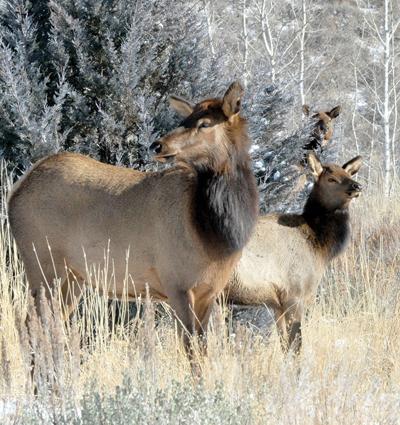
The U.S. Forest Service will have to give the public time to review any authorizations for the use of helicopters to collar elk in the Frank Church-River of No Return Wilderness.
A federal appeals court has upheld a lower court decision requiring the U.S. Forest Service to wait 30 days before authorizing the use of helicopters to conduct wildlife-management operations in the Frank Church-River of No Return Wilderness to allow time for public challenges.
The ruling Monday from the U.S. Court of Appeals for the Ninth Circuit upheld an injunction that prevents the Forest Service from using data gathered from radio collars installed on 57 elk in 2016 because the Forest Service approved the helicopter operations in violation of two environmental laws.
In 2016, the Forest Service allowed the Idaho Department of Fish and Game to conduct 112 helicopter landings in the wilderness area to capture and place radio telemetry collars on the elk. Fish and Game also captured and radio-collared four wolves—an action that had not been authorized by the Forest Service.
Idaho District Judge B. Lynn Winmill ruled those actions unlawful in 2017 because the Wilderness Act prohibits the use of motorized vehicles, including helicopters, in wilderness areas except when needed for wilderness management, and the National Environmental Policy Act requires thorough environmental analysis of these types of actions on federal lands.
The helicopter operations were part of Fish and Game’s program to increase elk numbers by eliminating wolf packs. Elk and predator management plans call for eliminating 60 percent of the wolf population in the Frank Church-River of No Return Wilderness.
Environmental law organization Earthjustice represented Wilderness Watch, Friends of the Clearwater and Western Watersheds Project in challenging the Forest Service’s decision.
“The court appropriately reminded the Forest Service that it must protect wilderness on public lands, including from state wildlife agencies seeking access to wild places and important habitats,” said Greta Anderson, deputy director of Hailey-based Western Watersheds Project, in a press release.
Tim Preso, managing attorney with Earthjustice, said in an interview that the ruling will give environmental organizations time to challenge any future proposals to use helicopters for wildlife management in the wilderness.
“We would look at the facts and circumstances of any decision they made,” Preso said.
IMAGE: BISON IN YELLOWSTONE'S NORTHERN RANGE. view more
CREDIT: BOB BESCHTA, OSU
CORVALLIS, Ore. - Increasing numbers of bison in Yellowstone National Park in recent years have become a barrier to ecosystem recovery in the iconic Lamar Valley in the northern part of the park, according to a study by Oregon State University scientists.
In the valley, foraging by bison exerts 10 times the environmental pressure of elk, historically the area's dominant herbivore - that's a problem because bison are powerful "ecosystem engineers."
Large numbers of bison disrupt species distribution across shrub steppe and grasslands. They do so via what they eat, trample and rub their horns and bodies on - i.e., tree bark. Thus, bison have tremendous capacity to limit the structure and composition of woody plant communities.
That in turn affects the character of riparian plant communities, as well as stream and river channels, altering habitats and food webs for terrestrial and aquatic wildlife species alike.
The findings were recently published in the journal Food Webs.
In the United States, the range of the bison originally ran from east of the Appalachians to west of the Rocky Mountains, with most of them living on their evolutionary home base, the Great Plains.
Their numbers once totaled an estimated 30 million, perhaps more, said OSU College of Forestry researcher Bob Beschta, corresponding author of the Lamar Valley ecosystem study.
"The bison population sharply decreased in the 1800s and their distribution became more constricted as European-Americans extended their influences westward across the country," Beschta said.
By the 1830s, there were no bison east of the Mississippi River or on the Snake River Plains. Fifty years later, the Plains bison were close to extinction.
"Several small herds were reported near Yellowstone National Park just before the park's establishment in 1872, perhaps driven there by hunting pressure on the Great Plains," said study co-author Bill Ripple, also of the OSU College of Forestry. "Poaching of bison occurred after park establishment, until 1901, at which time only 22 bison were present in the park."
In 1907, more than 60 bison from a growing herd in the Mammoth Hot Springs area of Yellowstone were transferred to the Lamar Valley. By 1925 the Lamar Valley bison herd had grown to more than 750, necessitating population reduction measures. Culling of the Lamar herd continued for more than four decades.
Meanwhile, National Park Service managers became increasingly concerned about the environmental effects of Rocky Mountain elk in the park's northern range, which includes the Lamar Valley, and began to cull them as well. In the early 1900s both gray wolves and cougars, predators that influenced elk behavior and density, had been extirpated.
In the absence of these predators, combined with hunting prohibitions inside the park, wintering elk populations began to heavily browse young woody plants in the northern range, which led to a decrease in "recruitment" - the growth of seedlings and sprouts into tall saplings and trees - of quaking aspen, cottonwood, willow, thinleaf alder and berry-producing shrubs.
Culling of both elk and bison stopped amid public and congressional concerns in 1968, at which time there were about 4,000 elk and 100 bison in the northern range. Within two decades, those numbers had increased to 20,000 and 1,000.
Cougars returned to the northern range in the 1980s, followed by wolf reintroduction a decade later, thus restoring the park's guild of large predators.
"Changes in elk behavior were observed shortly after the return of wolves" Beschta said. "And, with predation pressure from wolves, cougars and grizzly bears, a degraded winter range, and human hunting of elk that wintered outside the park, annual counts of the northern range elk herd began to decrease from their historical highs in the 1990s."
In the years since wolf reintroduction, the northern range's elk population has declined to about 5,000, with most them wintering outside the park. Bison numbers inside the park, on the other hand, have increased to a historical high of about 4,000.
Deciduous woody plant species in many areas of the northern range started to increase in establishment, young plant height, diameter growth, recruitment, canopy cover and berry production - all associated with reduced browsing pressure from elk.
"But in portions of the northern range, like the Lamar Valley where bison are common, woody vegetation has continued to decline," Ripple said. "We hypothesized that was because of the bison. We also hypothesized that bison, via the suppression of riparian vegetation and trampling of streambanks, may be increasingly influencing the channel of the Lamar River and tributary streams that cross the valley floor."
Photo analysis indicated a near complete loss of willow-dominated riparian communities for at least some parts of the Lamar River and the West Fork of Rose Creek.
"And the roughly 7.5 hectares of aspen stands that were present on the valley floor in 1954 had diminished to one-tenth of a hectare by 2015, representing a 99% loss in the cover of overstory aspen trees," Ripple said. "The rapid increase in bison numbers in recent years suggests the park's large carnivore guild may be incapable of controlling bison populations. And prey switching by wolves - from elk to bison - looks unlikely to provide a stabilizing effect on bison populations."
The researchers stress that the long-term recovery of the Yellowstone bison herd has been a major conservation success story and, as one of the few remaining herds that has not hybridized with cattle, Yellowstone bison "are an invaluable conservation resource."
"However, increased bison numbers over the last two decades appear to have come at a major ecological cost to the biological diversity and functioning of the riparian ecosystems in the Lamar Valley," Beschta said. "Even to a casual observer there are clear indicators of highly altered ecological conditions across the Lamar Valley, including a high density of bison trails, wallows and scat. High bison numbers have been an effective agent for accelerating the biological and physical modification of the valley's seeps, wetlands, floodplains, riparian areas and channels, trends that had begun decades earlier by elk."
Ecosystem simplification - a loss of biodiversity, landscape complexity and ecological integrity - is well underway, much like as is associated with high levels of domestic livestock use in areas of the mountain west, Beschta added.
"The ongoing environmental effects of bison would have to be significantly reduced in order to restore biologically diverse communities dominated by willows, cottonwoods and aspen," Beschta said. "As park administrators make management decisions that affect ungulate densities and distributions in Yellowstone, as well as those in other parks and reserves with high ungulate densities, our findings indicate a need to take into account the often wide range of ecological effects that abundant large herbivores can have on terrestrial and aquatic ecosystems."
San Diego Zoo Global researchers studying the effects of climate change on polar bears are using innovative technologies to understand why polar bears in the Southern Beaufort Sea are showing divergent movement patterns in the summer. In recent decades, about a quarter of this population of bears have chosen to come on land instead of staying on the shrinking summer sea ice platform. Historically, the polar bears in this region remained on the ice year-round. The decision of each individual bear to stay on the ice or to move to land appears to be linked to the energetic cost or benefit of either option, and the potential of having to swim to reach land.
"We found that bears who moved to land expended more energy on average during the summer than bears that remained on the receding sea ice," said Anthony Pagano, Ph.D., a postdoctoral research fellow co-mentored between San Diego Zoo Global, the U.S. Geological Survey and Polar Bears International. "And in the late summer, as the ice became even more restricted, a greater percentage of energy was expended by bears swimming to land. This means the immediate cost of moving to land exceeded the cost of remaining on the receding summer pack ice -- even though bears are having to move greater distances to follow the retreating sea ice than they would have historically."
However, prior research has shown that bears on land in this region have access to whale carcasses in the summer, while bears on the sea ice appear to be fasting. Researchers are concerned that the decision by each individual bear to stay on the ice is creating an ecological trap that may be contributing to population decreases that have already been documented in this population.
The Southern Beaufort Sea subpopulation of polar bears has experienced increased sea ice retreat in recent decades. A basic understanding of polar bear energetics that can be applied to this research has come from studies that include polar bears at the San Diego Zoo and at the Oregon Zoo.
"The polar bear conservation program at the San Diego Zoo has supported research such as this by engaging in studies to measure the energetic costs of polar bear metabolism," said Megan Owen, Ph.D., director of Population Sustainability, San Diego Zoo Global. "These studies have enhanced the capacity of field researchers to interpret data collected on free-ranging bears, providing a better understanding of what it costs a polar bear to move about their rapidly changing habitat."
"The research underscores the importance of taking action to reduce the greenhouse gas emissions that are causing sea ice to melt," said Steven Amstrup, Ph.D., chief scientist at Polar Bears International. "It's yet another piece in the climate puzzle, showing the impacts of global climate warming on polar bears and how the bears are responding to sea ice retreat."
The Himalayan wolf is considered an ancient wolf as it evolved prior to the contemporary grey wolf which is found in large parts of North America and Eurasia. Very little is known about the Himalayan wolf, because science and conservation have overlooked these high-altitude wolves as just another grey wolf until recently. As a result, very little research had been conducted on this wolf and no conservation action has been in place, risking a silent population decline of this wolf. This research, published today in the Journal of Biogeography, reveals this wolf's evolutionary uniqueness based on many different genetic markers; including a genetic adaptation to cope with the high-altitude environment, which is an adaptation that is not found in any other wolf. The Himalayan wolf is a top carnivore in the Asian high-altitudes, which hold some of the last intact large wilderness areas on our planet. The protection of the Himalayan wolves is critical to preserve these ecosystems given that top carnivores are key to keep an ecosystem healthy and balanced. This becomes even more relevant when considering that the Asian high-altitudes hold the water resources for billions of people in south-east Asia and it is of global interest to keep those ecosystems and their wildlife populations healthy.
The insights gained in this research by scientists at the University of Oxford's Department of Zoology further inform the development of long-term sustainable conservation plans for these wolves and their high-altitude ecosystems.
Lead researcher, Dr Geraldine Werhahn of WildCRU, Department of Zoology, says: 'The outcome of this research is absolutely astonishing. When we started out in 2014 it was surprising how little was known about these wolves inhabiting a relatively large region of our planet. At the time the scarce data available was indicating a genetic difference, but we had no explanation for why these wolves are different from a grey wolf.'
'Now we know that these wolves are different from genetics to ecology, and we have an indication of what the reason may be: the evolutionary fitness challenge posed by the low oxygen levels in the extreme high altitudes. When we started this research we thought this wolf is found only in the Himalayas, but now we know that they are found in the entire high altitude regions of Asia comprising the habitats of the Himalayas and the Tibetan Plateau. Much still remains to be revealed about their ecology, behaviour and population size. But the time to protect them is now!'
The researchers observed where the wolves chose their den sites and found that in Nepal the Himalayan wolf pack sizes are on average five animals and hence smaller than usual grey wolf packs. These insights into the wolves' social life combined with observations on the livestock herding practices in these high-altitudes helps to identify areas of immediate conflict between herding and wolf pup rearing and propose mitigation action. The researchers observed exclusive denning behaviour of Himalayan wolves and their pups.
The studies used wolf scat sampling for genetic and genomic research to understand their evolutionary history based on a wide array of different genetic regions. It also used the scats for a dietary study, investigating what prey species the wolves and other carnivores have eaten. The researchers studied which prey species and at which amount were eaten by the wolves and compared that to the abundance of these same prey species in the landscape to understand what the wolves had available and what they have actually taken.
The researchers found that the Himalayan wolf use more wild prey species than livestock when considering their availability and identified the main prey species for the Himalayan wolf. Livestock is seasonally often more abundant in the habitats than wild prey species, which poses two problems. Firstly, the wolves encounter much more livestock than wild prey. Secondly, livestock competes with wild prey for food and space and often displaces wild prey species. As a result, the wolves are left with little choice but to kill livestock. This is a key finding for developing conservation action for the Himalayan wolf, with solutions being to restore and protect wild prey populations and working towards sustainable livestock herding practices.
The main conservation threats appear to be the killing of wolves to retaliate livestock depredation, as well as for selling body parts in the flourishing illegal wildlife trade. Livestock is a major livelihood of many local communities in these harsh high-altitude environments, and losses of livestock has serious financial consequences for people. Improving livestock protection and sustainable management can mitigate depredation conflict substantially. Illegal wildlife trade involves many wildlife species found in these high-altitude regions, with the animal parts often traded for high prices. This illegal wildlife trade needs to be drastically combated from political to ground level across the countries to the benefit of many wild species.
In addition, a social survey study with local communities helps to understand what people want and need to be able to commit to wildlife protection in these regions.
Local people expressed the wish to be closely involved in conservation work. Community conservation groups have proven successful in Himalayan areas.
These research findings can now be used as data basis to formerly recognize the Himalayan wolf as an own wolf taxon (giving it a scientific (Latin) name). This formal taxonomic recognition paves the way to assign it an IUCN conservation status. These are the two pivotal steps now required to advance the conservation of these wolves and their habitats.
With these fundamental researches now accomplished, moving forward research is planned to explore behavioural and more detailed ecological aspects around these wolves, while also piloting a conservation action plan with the local communities to develop a plan for the Himalayan wolf that shall be applicable across the Himalayan region in the long term.
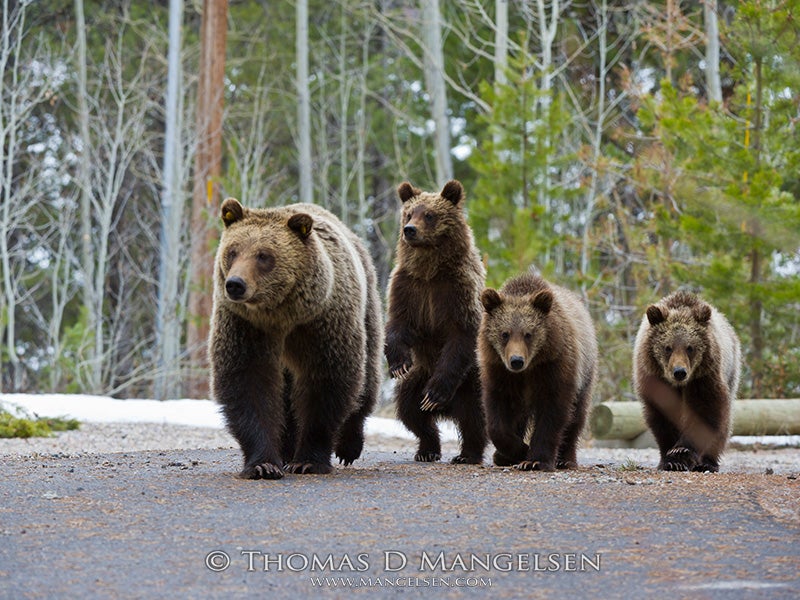
Grizzly 610 walks down a park road with her three cubs in springtime, April 13, 2012.
Photo courtesy of Thomas D. Mangelsen
This
is a victory for the bears and for people from all walks of life who
come to this region to see the grizzly in its natural place in the
world.
Timothy Preso
Managing Attorney, Earthjustice
September 24, 2018
Missoula, MT — Federal safeguards for Greater Yellowstone Ecosystem grizzly bears were reinstated today, after a judge ruled that the Trump administration’s decision to strip Endangered Species Act protections from the population was illegal.
The decision spares the grizzlies from a planned trophy hunt
scheduled to begin this fall in Wyoming and Idaho. Earthjustice,
representing the Northern Cheyenne Tribe, Sierra Club, Center for
Biological Diversity and National Parks Conservation Association, argued
for restoring protections to Yellowstone grizzly bears.
Document
Pages
Text
Zoom
“The grizzly is a big part of why the Yellowstone region remains among our nation’s last great wild places,” said Earthjustice attorney Tim Preso,
who argued the case. “This is a victory for the bears and for people
from all walks of life who come to this region to see the grizzly in its
natural place in the world.”
“The Northern Cheyenne Nation views the grizzly bear as a relative entitled to our respect and protection from harm,” said Lawrence Killsback, President of the Northern Cheyenne Nation.
“We have a responsibility to speak for the bears, who cannot speak for
themselves. Today we celebrate this victory and will continue to
advocate on behalf of the Yellowstone grizzly bears until the population
is recovered, including within the Tribe’s ancestral homeland in
Montana and other states.”
“We’re glad the court sided with science instead of states bent on
reducing the Yellowstone grizzly population and subjecting these beloved
bears to a trophy hunt,” said Bonnie Rice, Senior Representative for Sierra Club’s Our Wild America Campaign.
“Changing food sources, isolation, inadequate state management plans
and other threats that grizzly bears continue to face warrant strong
protections until they reach full recovery.”
“People around the world will applaud the decision to again protect
Yellowstone’s beloved grizzly bears under the Endangered Species Act,”
said Andrea Santarsiere, a senior attorney with the Center for Biological Diversity.
“Facing ongoing threats and occupying a fraction of their historic
range, grizzly bears are nowhere near recovery. These beautiful and
beleaguered animals certainly shouldn’t be shot for cheap thrills or a
bearskin rug.”
“Grizzly bears that call Grand Teton and Yellowstone National Parks
home will no longer be threatened by an aggressive hunt that was planned
this fall on lands bordering the national parks, thanks to the court’s
ruling,” said Bart Melton, Northern Rockies regional director for National Parks Conservation Association.
“The Department of the Interior can now go back to the drawing board to
hopefully consider what research, such as the long-term impacts of
climate change on the population, must be considered to ensure a healthy
long-term future for Greater Yellowstone Ecosystem grizzlies.” Read the court decision.
Background
In August 2017, the U.S. Fish and Wildlife Service removed the
Yellowstone-region grizzly bear population from the federal endangered
and threatened species list, even though the area’s grizzly population
has suffered high levels of human-caused deaths in recent years.
This fall, for the first time in more than 40 years, the states of
Wyoming and Idaho announced grizzly hunts that would have allowed for up
to 23 bears to be killed outside of Yellowstone National Park. Today’s
court ruling blocked the hunts. The court had previously issued an extended a temporary restraining order to prevent the hunt from proceeding while the judge finalized his decision.
The Northern Cheyenne Tribe and conservation groups challenged the
Fish and Wildlife Service’s disregard of bear deaths following the
bears’ recent shift to a more heavily meat-based diet following the loss
of other foods.
The tribe and groups also faulted the Service for carving out and
delisting the isolated Yellowstone grizzly population instead of
focusing on a broader, more durable grizzly recovery in the West. They
further challenged the Service’s decision to disallow public input on
changes to its management framework for grizzlies, which weakened
protections. Learn more about the legal fight.
Basic cooperation skills appear to be
shared by dogs and wolves, suggesting that this ability was present in a
common ancestor and was not lost during domestication
Max Planck Institute for the Science of Human History
A team of researchers have found that dogs and wolves are equally
good at cooperating with partners to obtain a reward. When tested in
same-species pairs, dogs and wolves proved equally successful and
efficient at solving a given problem. This finding suggests that basic
cooperation abilities were present in a common ancestor of dogs and
wolves, and have not been lost in the domestication process.
It is estimated that dogs were domesticated as much as 30,000 -
40,000 years ago, and over that span of time they have undergone many
changes from their wild counterparts, wolves. In a study published in
the Journal of Comparative Psychology, researchers tested dogs
and wolves for the ability to coordinate their actions with a partner of
the same species to obtain rewards. The wolves in the study were from Tierpark Petersberg and Wolfcenter Dörverden.
The researchers from the Max Planck Institute for the Science of Human
History, the Max Planck Institute for Evolutionary Anthropology, and
colleagues, found that dogs and wolves performed equally well on the
task, suggesting that this ability was present prior to dogs'
domestication in a common ancestor. The researchers hypothesize that,
since dogs have been specifically selected for their ability and
willingness to cooperate with humans, they might have an even higher
success rate when humans are the cooperation partner. The Test Scenario: Hunting large prey
To test cooperation ability, the researchers created a test scenario
that was designed to mimic a hunting situation, one in which multiple
animals were trying to take down a larger herbivore, such as an elk or
other horned prey. The concept was that, in the wild, one of the animals
would need to draw the attention - and the dangerous horns - of the
potential prey, so that the other could attack from the rear and bring
the prey down. Thus the animal that took the most risk in the hunt also
had to trust that it would be given a share of the reward in the end.
The test apparatus involved a barrier separating the participants from a
food reward, with two openings on opposite ends that were controlled by
a researcher. When the first animal approached an opening, the door
before it would shut while the opposite door remained open, allowing the
partner to enter first and access the food. The door then remained
open, so that other animal could then enter. Thus the animals had to
cooperate in two ways - first by positioning themselves on opposite ends
of the barrier and then by timing and coordinating their approaches
towards the barrier.
The researchers found that the dogs and wolves were equally
successful, succeeding in about three out of four trials on average.
"Dogs were not outperformed by wolves in coordinating their actions, in
the frequency of success or in how long the task took," explains Juliane
Bräuer of the Max Planck Institute for the Science of Human History,
lead author of the study and head of the DogStudies group at the
institute. "This is somewhat surprising, as it contradicts recent
findings by other researchers related to more complex cooperation tasks
performed by dogs and wolves." The researchers hypothesize that this
could be due to the simple nature of the task in the present study,
which might require only basic cooperation skills. Food sharing depends on the dynamics of the pair, not on species
After solving the test, the pairs generally shared the food reward,
but sharing was more likely when the dominant member of the pair was the
second to arrive at the reward. "The probability of co-feeding during
successful trials was higher when dominants 'took the risk,' so to
speak, in moving first and drawing the closed door, because their higher
rank gave them a higher chance to nonetheless get their share even if
they accessed the food reward a few seconds after the subordinate,"
explains Bräuer. So while the researchers set out to test cooperation,
it turned out that competition within the pair was also a factor.
Interestingly, however, dogs and wolves seemed to differ in which
animal in the pair was willing to move first, drawing the closed door
and thus being second to the food. Dominant wolves seemed to be more
willing to take on this task in general than dominant dogs, and did so
more frequently the more times the pair shared food. Dominant dogs, on
the other hand, apparently seem to prefer to wait for their partner to
draw the closed door. As would be expected, the more times dogs shared
food, the more likely the subordinate member of the pair was to move
first and draw the closed door. More complex cooperation remains to be investigated
The researchers point out that, although the kind of coordination
shown in the present study may rely on more simple mechanisms than full,
conscious cooperation, it can still inform us about how cooperative
behavior might have changed - or not - during the domestication process.
"Our results suggest that the abilities needed to coordinate actions
were already present in the dog-wolf ancestor," notes Bräuer. "In future
studies, it would be interesting to focus on the question of how
exactly factors like social dynamics, living conditions, the type of
task and maybe also breed differences influence the cooperative behavior
of dogs and wolves."
It's a familiar scene to anyone who's
watched footage of brown bears catching sockeye salmon in Alaska:
They're standing knee-deep in a rushing river, usually near a waterfall,
and grabbing passing fish with their paws or jaws.
But a new study published in the journal Conservation Letters
reveals a different picture of how and when bears eat salmon. Most of
these bears, also known as grizzlies, are dipping into small streams to
capture their iconic prey.
Using a foraging model based on the Wood River basin in southwest
Alaska, a study team led by Oregon State University determined that
while small-stream habitats have only about 20% of the available salmon
in the watershed, they provide 50% of bear consumption of salmon.
"This tells us that populations of sockeye salmon that spawn in
little streams are disproportionately important to bears," said study
lead author Jonny Armstrong, an ecologist at Oregon State University.
"Bears profit from these small streams because they offer salmon at
unique times of the season. To capitalize on plentiful salmon runs,
bears need them to be spread across time."
Small streams typically have cold water, which leads to populations
of salmon that spawn much earlier in the season when no other
populations are available to predators such as bears.
These results have potential consequences for how environmental
impact assessments are conducted and evaluated for large projects such
as the proposed Pebble Mine in Alaska's Bristol Bay.
These reports typically focus on how the project will affect the
abundance of salmon in lakes and rivers, but they usually overlook
smaller habitats, Armstrong said.
"When people want to build a large mine, they think these streams
don't matter because they represent a small fraction a watershed, in
terms of area or salmon abundance. In conservation and management, we
generally place value on the largest runs of salmon at the expense of
the smallest ones," Armstrong said. "If we pose a different question and
ask which habitats are important for the ecosystem, then small streams
become particularly relevant."
The researchers developed a mathematical model that explores how
watershed development and commercial fisheries affect how many sockeye
salmon are available to grizzlies. The model simulated different
patterns of development and explored how they affected the number of
salmon bears consumed.
Protecting large salmon runs at the expense of smaller ones turned out to be bad for bears.
"This causes the bears' total salmon consumption to drop off faster
compared to strategies that protected small salmon runs and the early
feeding opportunities they offer to bears," Armstrong said. "If you
impair these areas, you may only reduce the total number of salmon by a
little, but the number of salmon that end up in bear's stomachs -- you
could reduce that a lot."
According to the study authors, there are two significant reasons why
the largest bears in the world are drawn to small streams to eat
salmon.
First, the fish in these streams are easy to catch for adult and
juvenile grizzlies. And second, because the water is colder than in
lakes and rivers, salmon spawn in them earlier -- probably to give their
eggs more time to incubate, the authors said. So, the fish are
plentiful by the first week of July -- making them the first places
bears fish after they emerge from hibernation.
"When they come out of hibernation, the bears are just scraping by
and barely making it," Armstrong said. "Having these streams means they
can start eating salmon in early July, which is about six weeks before
the river- and lake-salmon populations start spawning and become
available to bears. It's an incredible foraging opportunity for bears."
Armstrong added, "I'm sure that native Alaskans who subsisted on salmon were keenly aware of this, too."